Friday, December 7, 2012

Taking the maxitaxi

          “Go big or go home,” my fellow student Jenna King likes to say, “and since home is too far away, we've got to go big.” With this in my head, I stepped out of my comfort zone with a giant leap one Friday afternoon in October. Alone, I climbed onto a maxtitaxi heading for Petroşani, the biggest town in the Jiu Valley, armed with instructions on how to find someone who would lead me to my first IMPACT club meeting. My big girl pants were on and I was traveling out of Lupeni on my own for the first time – without program director Kadie Becker, without my fellow students or anyone else I knew. I slightly remember being enamored with the natural beauty of the Jiu Valley, but I was definitely more concentrated on counting the number of stops the maxitaxi made as well as the knots in my stomach. I had been told that someone would find me when I got off in Petroşani to take me to my IMPACT club. So I walked off my ride at the right number of stops, determined not to show any fear on my face. A friendly voice called out my name as I walked off the maxitaxi, and I was greeted by two New Horizons Foundation employees who took me to my meeting (which turned out to be a very pleasurable experience, despite my fears).
           The ride home to Lupeni was much more enjoyable than the earlier ride. I remember taking in the scenery with fresh eyes, my soul filled with relief and awe. Summer still clung to the trees of the valley and the air was still warm. A few flowers were still blooming and the fruit trees were still laden with their produce. Brightly colored clean laundry hung in balconies in each town we drove through - Petroşani, Vulcan, Aninoasa and Lupeni.
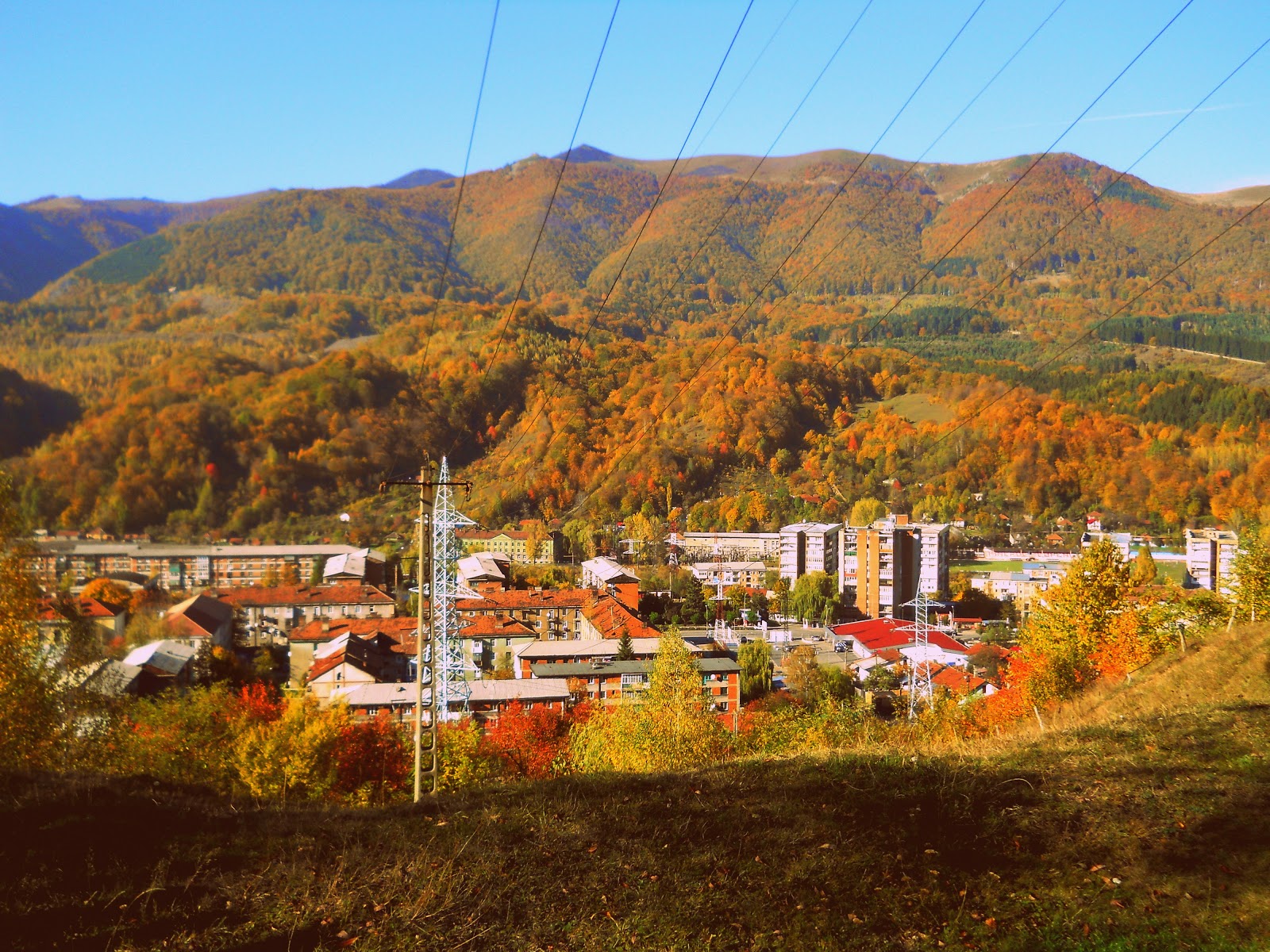
           In early November, the ride to Petroşani was full of more life than I could comprehend. Autumn had come in full force after fall break; red, yellow, orange and gold leaves covered the sides of the valley. The natural colors complimented the red slate roofs and the vibrantly colored Romanian homes which filled the spaces between the towns in the valley. I was getting more comfortable with my IMPACT club, I felt at home with the student group, I had just returned from an amazing vacation in Greece, and like the trees, I was full of life. The sun had just entered the golden hour before sunset and illuminated the autumn colors of the trees on the hills and mountains on both sides of road towards Lupeni.
        Today, a gloomy and frigged December day, was last time I took the maxitaxi to Petroşani. The autumn colors of the hills had been replaced with steel grays, blues, purples, whites and browns as snow covered the ground and matched the gray color of the sky. The mountain tops were hidden by the low hanging winter clouds, and the natural hues of the valley matched the drab colors of the old factories and mines between Lupeni and Petroşani.
        Each of these rides have been a rest from the world as I stared out the window of the maxitaxi for 45 minutes each way to Petroşani and back. October, November and December showed me different seasons of the Jiu Valley and of myself as well. I can't understand the ways I've changed yet, but I know that I have gone through many changes in these past months. On my final ride, the colors of the sky matched the colors of my heart as I said goodbye to my favorite part of the week and started a week full of painful goodbyes. I had just said goodbye to my wonderful IMPACT club and had my last cup of crappy vending machine coffee. I am still in the process of figuring out how to say a good farewell to Romania – the people, the places and the part of myself I will leave here. This next week will be a rough journey of finding ways to say "ne vedem" - until next time. 


Thursday, December 6, 2012

Silent Words


This semester started out with so many ideas inspired by a desire to make the most of being here and trying to remember all of it. The ups and downs, happies and crappies, roses and thorns; however you like it. One of the ways I thought to preserve these memories was to blog.

Obviously that didn’t go so well.

I sit here, wrapped like a burrito in multiple layers as one of two heaters in the apartment warms the room. Apartment Lucy to be more specific; which is also dearly loved by three amazing women whose names three months ago I was still trying to remember and now am proud to call my sisters. The idea of having to say goodbye to them a week from now brings sad and bitter tears to my eyes. I am humorously reminded of the stages of grief and realize that I am in denial, but at least I can accept this.

How am I going to say goodbye to everyone? This question has been littering my thoughts the past two weeks and frankly it is quite draining, because I don’t know.  About any of it. I don’t know how to leave like this, or if we’ll keep in touch. I don’t know how to spend the little time I have left, I don’t know what to say to everyone who has impacted my life this semester, and I don’t know how I’m going to be able to walk away from them. Realistically, we will all arrive at the airport and have to look each other in the eyes as we give one last hug and kiss on the cheek, a tradition we have all grown very fond of, and force the word “goodbye” out of our mouths. Yes, that is how I will literally say it. Those are the concrete actions I will robotically carry out, but that word and those gestures can’t possibly encompass the true nature of the moment. The moment when silent words are what will mean the most and time is our only enemy. I will wave and smile one last time, and I will not look back because it will hurt too much to have to look away again.

I guess some will read this and smile, thinking to themselves “oh it’s so nice she was able to get so close to them”, others might roll their eyes feeling I am being overdramatic; and yet there are a few out there who will read this and  understand what I mean. What all of it meant. Not just this short reading, but what it is about. Falling in love with a land and an adventure and feeling your heart tear at departing from it. Letting complete strangers in and developing unexpected bonds, but being beyond frustrated that knowing over time you will forget each other.

Maybe that is what evokes such strong words, knowing that I will forget. The feeling of stepping outside and seeing the mountains every day, the quirky moments shared between friends and even strangers, and what it was like to live with nine unbelievable men and woman in an adventure of the unknown. I will not forget all of it, but I will forget; and this is what fuels my sadness and my anger.

One day, years from now, I will look back on this time and I will remember something. Perhaps it is in that moment that I will find what made it so hard to say goodbye.


Monday, December 3, 2012

Notes from an Intern


 For the semester, one of my colleagues and I have taken up internships in the New Horizons Foundation's office in Lupeni. Our official job title lists us as “English-Language Communication Assistants”. This position primarily consists of taking materials that where originally written in Romanian and have since been loosely translated into English, and perfecting them to be concrete and comprehensible materials for native English-speakers. Why is this important you might ask, if New Horizons is a Romanian organization, therefore with a Romanian audience? Well, because NHF is such an easily replicable organization, IMPACT groups have begun to spread within the United States. By improving the quality of materials in English, it’s hoped that the IMPACT program will become increasingly accessible and adaptable, and hopefully flourish on an even greater scale. One of the things I personally find so cool is that a community does not have to work to fit itself to an IMPACT club; rather, the IMPACT club adopts to fit the needs of a community. And really, shouldn’t this be the way all good deeds flow?

I originally wanted to intern with NHF to see community development work at an up close and personal level. From what I observe on a daily basis, NHF works as an umbrella and a resource for their clubs across Romania. They do not follow the details of each club meeting, nor do they force clubs to pick certain projects that they see as optimal. This might allow room for messing up; a club might have ups and downs as a group, or might have a project that is a total flop. However, I get the sense that this is ok, because all the while club leaders and members were using their minds and energy to see what their community's needs were. And that is one of the biggest things a development organization can hope for, because changing one’s mindset to think beyond oneself is the only way we can breach the barrier of selfishness we each have, and begin to heal our communities as a whole. If my work to bring new materials to the table can help this along, well, then I consider my internship a success.

For more information on NHF or IMPACT check out: www.noi-orizonturi.ro


Sunday, December 2, 2012

Tuberculosis: A disease caused by bacteria that float through the air, infect your body, and eat holes in your lungs so that you can’t breathe and eventually die.  Well, that’s the TB 101 version, but you understand; it’s nasty stuff.

Contrary to popular belief, both Romanian and often American, Tuberculosis (TB) is not solely reserved for the pages of dusty history books or tales of great grand-parents.  It is very much alive and well in much of today’s world.  In Romania, the last reported incidence of TB was 101 cases per 100,000 residents in 2011.  Though this rate has been slowly decreasing, the enormity of the problem is staggering.  For comparison, the U.S. incidence rate in 2011 was 3.9 cases per 100,000 people.  Even Hungary, Romania’s neighbor and other post-communist country has a rate of 18 cases per 100,000 in 2011.  Clearly, something is going wrong. 

TB is a social disease, meaning that one’s social and economic conditions have a strong influence on one’s chances of falling ill and of being cured.  AKA: The poor get sick more and recover less.  Many of the problems are wrapped up in the highly complex and corrupt political and health system.  Medication shortages, ancient diagnostic technology that requires up to 6 weeks for results, and improper treatment methods that breed resistance are common.  But beyond the red tape of bureaucracy, there lies many deep social issues.  Difficult physical and psychological side effects make it impossible to work while undergoing treatment so that many of the poor cannot afford to stay on treatment.  Addictions, lack of family support or childcare while loved ones are far away being treated in isolation, and malnutrition add to the struggle.  Plus, many in Romania, even patients, misunderstand the nature of the disease, how it can be passed on, and what are safe ways of supporting a loved one with TB rather than stigmatizing them.

Poster for Romania's Stop TB Campaign

As a pre-physician assistant student, I was interested in looking deeper into the state of TB in Romania.  This semester I have been blessed with the privilege to develop an honors project under the under supervision of Jonathan Stillo, a PhD student in medical anthropology who has been doing research and advocacy work on TB in Romania for 6 years.  (For more background info on TB or Jon Stillo, see the blog from Nov 17, 2010 titled “Tuberculosis in Romania”).  With his guidance, I have spent this semester reading WHO reports, sociological studies, and other reports covering the status of TB in Romania.  At the end of October, I was given the chance to travel to Bucharest (the capital) for a weekend to conduct interviews with doctors, patients, nurses, and the psychologist at Marius Nasta, one of the Romanian centers of excellence for TB treatment.  It was an incredible opportunity and, as I told Jon afterward, simply having the ability to go and speak to those who are living out the realities and frustrations of TB gave me a much deeper and more personal look into the system than I could ever gain reading a global health report.    

However, to do research for research’s sake, especially in the case of a national health crisis seems frivolous.   So, the latter part of this semester has been spent working on developing a project proposal that will aim to tackle things which are holding TB patients back from a full recovery.  The idea is to present the proposal to Romanian donors who express interest in wanting to give toward the TB cause. 

As much of our time here is focused on creating social change, especially through the model of IMPACT youth clubs, I wondered if there would be a way to apply the IMPACT model to TB.  Dana (founder of IMPACT) and Jon had mentioned wanting to develop a partnership for several years, but neither had the time to create a project.  However, I have a foot in both camps and so put on my thinking cap to come up with a way to bring together all my worlds that are fighting for the good of Romania. 

I am currently writing a proposal for a nation-wide IMPACT project that begins as a month of meetings where youth clubs around the country learn about the basics of TB and are then be given the chance to design and implement a service project that addresses one TB-related problem of their choosing. Projects might include TB education in local schools, advocacy campaigns, and social supports for patients and their families.  As a celebration at the end of all the projects, there will be a nation-wide IMPACT party/ TB conference, highlighting some of the top projects as well as bringing IMPACT students and partners from the STOP TB Partnership together from all across the country to engage in TB advocacy and education.

The hope is to, through a critical mass of people all over Romania, spread the word about TB and spark a desire in kids to take action and demand change.  Romanians standing up for other Romanians is at the heart of IMPACT, and the potential to bring about positive changes in the lives of TB patients brings me much joy.  I look forward with anticipation to see where this project will lead in the future.

Check out Romania’s Country Profile for TB by the World Health Organization here: https://extranet.who.int/sree/Reports?op=Replet&name=/WHO_HQ_Reports/G2/PROD/EXT/TBCountryProfile&ISO2=ro&outtype=pdf

Read up on Jon Stillo’s new project for tracking medication shortages across Romania!  It just won a contest for funding through Restart Romania! :  http://lipsatratament.ro/despre.html

Friday, November 30, 2012

Wedded to Work


My host parents seemed to go to a wedding every weekend. Whether it was due to how surprisingly young they are and all of their friends are getting married, or that they are simply that popular, I could not tell. I also could not understand why they would not leave for the wedding until nine or ten in the evening only to return late in the night. Fortunately, one of the weddings was at our house so I got an invite.
When I say that the wedding was “at our house” I mean it started there. My host parents were the nașii (roughly translated into English as “godparents”), which meant that they were to stand alongside the couple and be witnesses for the entire ceremony. The guests and the groom gathered at our house around noon for finger-food, drinks, and dancing before going to pick up the bride. We then accompanied the bride and groom throughout each step: the signing of the marriage certificate, the service at the Orthodox church, and, finally, the reception. The whole journey was made into a party. The long caravan of cars drove along with ribbons and bows, honking and making a commotion in the streets, which to my surprise, was greeted by smiles and waves from onlookers. At one point, the car in front of me stopped and someone inside handed a bottle of țuica (plum brandy) to a few construction workers on the road. Every time we reached our destination a three-man band would play and two men adorned with Romanian tri-colored sashes made sure everyone had their fill of țuica. When we finally arrived at the reception hall and it seemed close to the end, it was really only just beginning. It continued on for hours over a six-course meal and dance after traditional Romanian line dance until, finally, around 5 am they brought out the wedding cake and things wrapped up.
Of all the differences between American and Romanian weddings, the length was what struck me the most– A total of eighteen hours. As I though about this difference, the words of a Romanian friend came back to me: “Americans work too much.” I began reflecting on America’s commitment to hard work and how it can overshadow other parts of life. Maybe that’s cliché, but as I sat there in the reception hall wondering why there were people passed their middle ages still dancing at 4 am, I began to see the difference more clearly.

Wednesday, November 28, 2012

Flooded by Grace


Over Thanksgiving, while all of our Romanian neighbors were going about their daily lives of work and home, we Americans were prepping ourselves for an evening of friends and feasting.  Yet, when all 4 of us entered into our kitchen built for no less than 2 cooks at once, and began to assemble all of the necessary items, we quickly realized that we were without an important ingredient: water.  As regularly occurs here (though this was our first experience in the apartments), the water had been shut off for the day.  Needless to say, the kitchen got significantly more chaotic.  3 hours later, we emerged, victors , with 4 homemade dishes in hand, ready to leave for a weekend at the cabin in Straja.  Unfortunately, in the midst of the chaos, we forgot to turn off the faucet, as there was no water currently coming out. 

“Currently” is the key word, because at 4 am our directors received a desperate call from our downstairs neighbors that their apartment was flooding.  Adi, the hero of the day, rushed over and spent the next several hours mopping up the small lake which had made its way from our kitchen, into the hall, and over half of the living room. When we received a call in the morning to inform us about the eventful previous night, I felt my heart sink and bury itself in the ground beneath my feet. 

Coming home to the apartment was nerve wracking.  Would our neighbors hate us?  Would they yell and scream, as they had every right to do?  Had we forever ruined NHF’s relationship with them?  My roommates and I huddled in the mostly-dry living room and memorized a speech in Romanian that we hoped would relay the depth of our sorrow and penitence, and knocking on their door, I shot up a quick “Help!” prayer. 

The man who opened the door looked confused, but soon realized who we were.  While I prepared for an angry tirade, he nodded and tried his best to discern our nervous, Romanian speech.  When we had finished, he said, “It’s ok.  Not a problem.  I understand.  Just be more careful next time and don’t let it happen again.”  Not sure we had understood correctly, we insisted several more times, “Ne pare foarte rau!” (We’re so sorry!).  And again, but with a smile, he only asked that we be more careful. 

Walking upstairs to our apartment, we marveled at his kindness and generosity to us.  When he could have been very angry, yelled, and demanded compensation, he forgave us and treated us so kindly.  I could not have asked for a more perfect example of human grace. 

Grace has begun to feel like a theme to our time here.  Operating in a new culture, there are so many instances in which I require grace.  My homestay family worked so hard to understand me, acting out words like charades or drawing pictures when we struggled to understand each other with words.   The students in my IMPACT club let me ask questions over and over and help to translate during the meetings.  And my fellow classmates, who have to live with me every day for four months give me the grace to have bad days, sad days, and to fail their expectations.

But it causes me to ask myself, how often do I give grace to others?  And how willingly?  I am apt to shut down or pull into myself when asked to go above and beyond for someone, especially a stranger, or to forgive someone who has seriously wronged me.  Yet so many Romanians have willingly opened their lives to me, and have continued to do so even when I inconvenience them, burden them, or even flood their home.  I have seen the incredible “Romanian hospitality” extend to include grace, and I am so thankful that it does.  They have reminded me that we all depend on each other and that just as I am in desperate need of human grace, I must give it just as freely so that others may experience grace as well.  

Wednesday, November 21, 2012

On the Jiu Valley

The Jiu Valley is the most beautiful place I've ever lived in. It lies in the Carpathian Mountains, nicknamed the Transylvanian Alps. I love seeing the sun rise and set behind the mountains on bright days, and the tops of clouds resting on top of the mountains on dreary days. Both sides of the valley came alive with autumn colors during October and make walks around Lupeni a joy. During my weekly 45 minute maxi taxi ride to Petroşani for IMPACT, I watch the trees explode with reds, oranges and yellows. It is one of the best parts of my week. 
Although it's bursting with natural beauty, you can't talk about the Jiu Valley without mentioning its stains - the run down factories, the web of power lines and the mismatched bloc apartments which serve as a constant reminder of Communism. Those in authority didn't care about preserving the natural beauty of the Valley - they only saw the coal under the mountains. So a tour through the Jiu Valley is both a feast for the eyes and a painful reminder of the past.
For the first six weeks I lived here, I saw the empty factories and the peeling paint on the blocs as romantic - horrible, I know. I saw Lupeni and the Jiu Valley through rose tinted glasses because it was new, exciting, and I didn't have to live the rest of my life in the shadow of the smoke stack you can see from any point in Lupeni. It wasn't until I read a line in Slavenka Drakulic's How We Survived Communism and Even Laughed that I realized how arrogant this was. She wrote about the broken streetlights on her street and how no one would fix them, and how an American had commented how quaint it made the street feel. The arrogance of considering a systematic failure "quaint" or "romantic" hit me in the face and I wanted to slap myself, along with the American who had made the comment. Life in post-communist Romania is real and hard. There is beauty in the hard work the people of Lupeni put in to make a home, and beauty in the mismatched fabric of old and new cultures creating a new tradition.
So the Jiu Valley is no longer romantic to me, but I like it better that way. The mix of natural and unnatural make a view that is breathtaking and truly Romanian. I will miss the Jiu Valley terribly when I leave in a few short weeks. It has been a blessing I will treasure for the rest of my days.
Here is a short video of Lupeni from one side of the valley. (Please ignore my horrible Romanian.)

Monday, November 19, 2012

On the Street Sweeper


Each day I see her. Maybe “have to look at her” would be more appropriate wording, because she’s not exactly a pretty sight.
She is always wearing the same baggy scarlet sweatpants tucked into a frayed pair of white tube socks.  The tube socks are peeking out of the top of a pair of black pleather boots, the pointed toes worn away just enough to allow her too-large feet to work the tip of her socks out through the hole as the days goes on, creating a strange little dirty sock nub. Her magenta sweatshirt might be the most disturbing part of the whole ensemble- no one has told her that it is inappropriate for 40-year-old women to wear pictures of Hannah Montana across their chests. Her body moves in a painful rhythm as she sweeps the streets of my bloc apartment complex. Every few steps her shiny red fingernails pull her rose-scented cigarette up to her lips and she takes a long drag. Sweep, sweep, drag. Sweep, sweep, drag.
She is dirty and defeated. Maybe that is why it stands out so much. It is perfectly pleated and lays across her head in an attempt to hide her frizzed mass of once-black hair, now mixed with stained orange sections and gleaming gray roots. It is not hastily pinned or knotted, but tied into a perfectly symmetrical and dainty bow that rests along her uneven hairline. It is not stained or ripped, and I’m sure that if I had the courage to approach her, it would not smell like the smoke and sweat that have saturated every other part of her life.
Though she may not be able to articulate such a thought, it is what remains of another world, another set of thoughts, another way of life- all of which have been brutally taken from her by time.
At first, it is shocking to hear the stories of her generation of Romanian’s nostalgia. A generation whose “Back in my day…” stories include food rations, misguided dictators, and whispered conversations in rooms with no power because of electrical shortages. But those sacrifices brought along with them a comfort. Under Communism, she (as well as everyone around her) had had what she needed. She had been a factory worker or a writer, or maybe even an engineer. She was proud of her work. Each day she came home with enough bread and vegetables for her family, and even had time to travel on the weekends. Silent acceptance of the system was the only price she had to pay for these luxuries.
 Now, she watches the people of Romania file past her each day as she sweeps the curb. Sometimes, she sees the few who had the right connections after the fall of Communism buzz past in their shining new cars. Sometimes, she sees the American girl with the huge backpack walk past and try to analyze her thoughts so she can write to her family about “the people over there” on her expensive laptop. Sometimes, she sees politicians travelling through town, paying for the desperate citizens’ votes with meat and beer. But mostly, she sees the families of Lupeni. There are so many children, but not enough jobs. There is so much trash, but not enough space. Their new “freedom” may have made them nearly invisible to the rest of the world, but she cannot help but see them.
She, like all of the people who pass her daily, remembers when she was able to be so much more.
That is why it is so much more than a floral headscarf.

Sunday, November 11, 2012

"Romenglish" and Other Musings


I decided to go for a run the Sunday before our final week of homestays.

My host family had been invited to attend not only one, but two birthday parties in town that day—both families insisted the American daughter be in attendance. I woke up early to take advantage of any free hour leading up to what was sure to be a long day of broken conversation in what I’ve come to affectionately call “Romenglish.” I diligently crammed phrases into my head before the run, scanning page upon page of jumbled notes from my language class.

I knew my efforts wouldn’t be of much service, and I felt a slightly defeated at the lack of connection that would come despite any attempts.

Heading back later, I saw an elderly couple taking a leisurely walk ahead of me. To my slight dismay, they stopped right on the intersection where I usually took a left to make my way home. I found my footsteps growing softer as I approached them, attempting not to make my presence known through the loud crunching of the gravel beneath my feet—I was not going to begin the awkward conversations this early in the day.

As guilt would have it, I realized what I was doing—Why didn’t I want to engage these people? It was clear I was American…there would be grace. So, why didn’t I initially jump on in? I took the dangerous first step and made eye contact as I approached. Of course they were already looking at me—they’re always looking.

I threw out a polite “Niata,” (a shortened form for “morning”) with a halfway smile. Right away, the woman of the pair took it upon herself to engage this strange person. As usual, she fired a string of Romanian words that meant absolutely nothing to my comprehension of the language. I stumbled out the phrase “I’m sorry, I know a little Romanian” in her native tongue, followed by the disclaiming phrase: “Sunt American.”

I automatically had a foreign air bestowed upon me—why was I here? When did I get here? How long would I stay? I tried my best to answer with a genuine effort and engagement, and did what we’ve all learn to do so well here: celebrate the little victories within ourselves when we can just barely follow along. When our conversation came to an end, I received the standard blessing that most Romanian elders bestow on the poor English-speaking souls who venture to engage them—It was if we’d each given each other the world through three minutes of connection.

Matthew 5:47 notes, “And if you greet only your brothers, what are you doing more than others?” The language barrier here can often feel like a much thicker curtain than it is, but disconnect can happen anywhere. After realizing how many people have squeezed their way into my heart despite this is both astounding and convicting.The familiar is always easiest, but “brothers” don’t become so unless we have the desire for family. To intentionally engage others anywhere in loving community—new and awkward community—requires a deep humbling of the self.
When we see that our oldest of relationships at one point took the same starting effort, we realize how different we can grow to be by expanding the family.
A growth that only occurs when we learn to love the language. 


Friday, November 9, 2012

The Abundant Life


The other day I was reflecting on the strong spirit of contentedness that has seemed to accompany my time in Romania. I was really trying to get to the root of this peace, because surely it was unnatural. Had I been living in the States with a half-suitcase full of clothes, 2 pairs of slowly falling apart shoes, and a Nalgene instead of my sophisticated Starbucks travel mug - I'm not so sure I'd be quite as happy. Ok, I'd probably be fairly miserable. Yet, I hardly miss any of the material things I left behind in the States. I'm very happy with my small wardrobe, and get almost embarrassingly enthusiastic when I can dress it up with second-hand scarves I find here for “un leu”. 

I've been free of a media feed for over 6 weeks now. That's not to say that I don't see Romanian commercials on occasion, or that I don't pass by billboards when I walk to the store, but the language and cultural barriers have made such things white noise. No brightly colored leaflets are telling me what style of jeans I don’t have, and I'm not jealous of my colleague’s latest fill in the blank, because they’re in the same boat. It's extremely comforting to know that you have enough, and it has really allowed me to rest in this belief that I am satisfied. On the other extreme, I feel I have abundance in partaking in joy. While in the States there's this constant feeling of guilt - I should be doing this, I shouldn't be eating that - but the abundant life doesn't allow for such questions to be asked. If a little old Romanian man is selling beautiful lollipops in the park, I’m going to have one and turn my teeth different colors, all the while having no regrets. It's a fascinating balance I'm starting to learn comes with habit, and one I needed to travel many miles to find. 

-Jenny Hyde
Gordon College